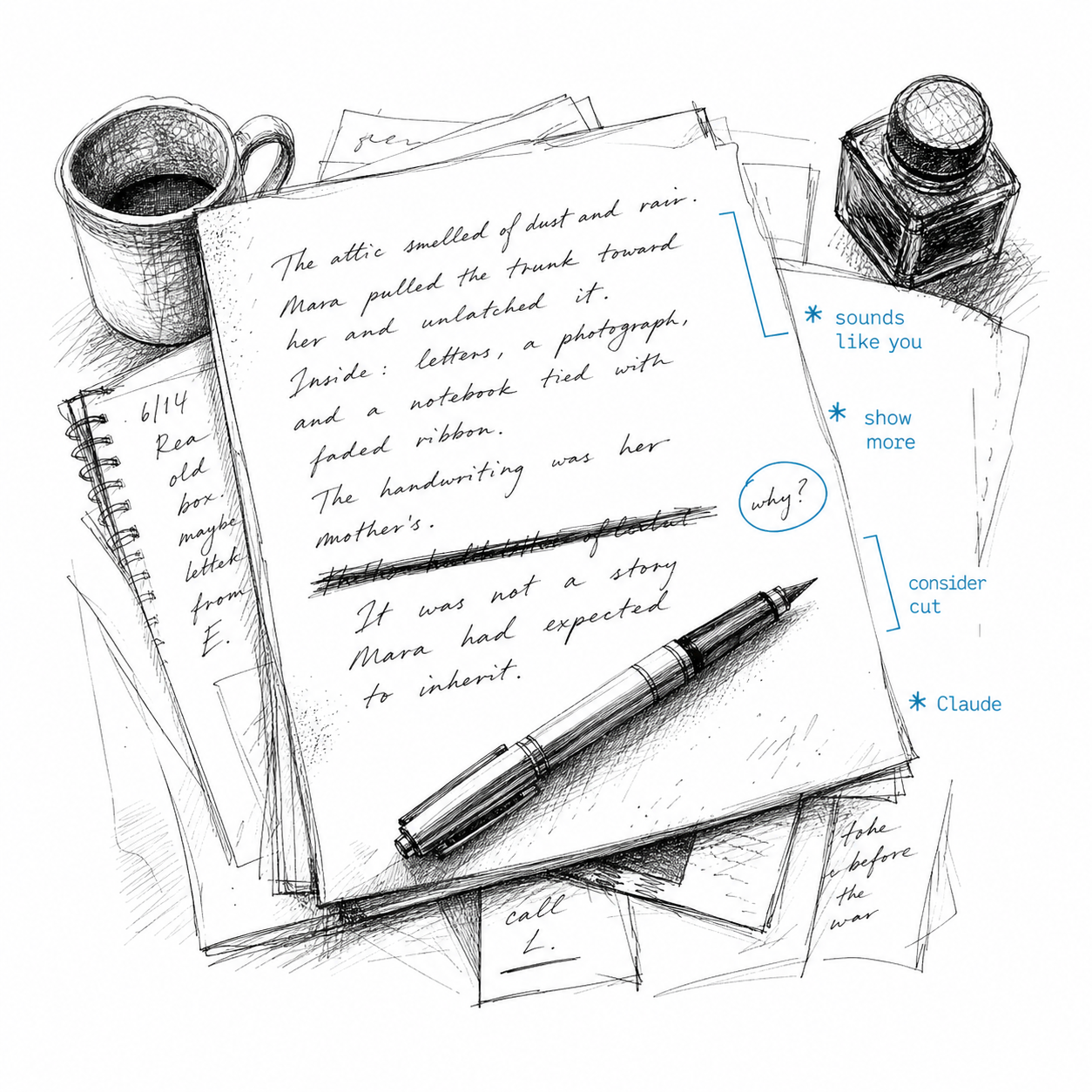
I was reading a friend’s website the other day. His perspective was sharp and his prose was unmistakably his — a style I’d never use myself, but one I couldn’t stop reading. And it struck me that this is the whole game when you write with AI. If you want to say something worth reading, use your own voice. Don’t hand it to the flattened, average voice of a machine.
To be clear, I lean on AI constantly. I use Claude to critique and edit almost everything I write. And when the goal is just to communicate — clear, accurate, done — letting AI draft it is fine. But that’s the exception, not the rule.
AI writes competent prose. Humans write identifiable prose. The voice is part of the message.
Mark Twain forged the American voice: colloquial on the surface, bottomless underneath. He also offended a great many people, and he still does. Huckleberry Finn is banned in schools to this day, even in editions scrubbed of its slurs, because the discomfort was never really in the words. It was in what Twain was showing us. He knew exactly what he was writing; he was no passive product of his time. Huck’s moral climax — “All right, then, I’ll go to hell.” — is the whole American conscience in seven words. AI would render it as: “I decided to accept the consequences and follow my own path, even if it meant a difficult choice.” Twain’s line gets quoted. The AI line gets skimmed.
Hunter S. Thompson is impossible to confuse with anyone else. There is exactly one gonzo journalist. Plenty of people can’t stand him, and honestly some of his writing is tedious and self-aggrandizing. But at his best he is savagely, humanly political, and we could use a 21st-century Thompson to scream at the state of things. He opens Fear and Loathing in Las Vegas with: “We were somewhere around Barstow on the edge of the desert when the drugs began to take hold.” Thompson writes from inside his own chaos — a chaos AI can catalog but never inhabit. Ask AI for the same energy and you get: “The night was wild and unpredictable, filled with strange visions and surreal encounters.” Parody, every time. The best it can manage is an impression.
Jack Kerouac is the least divisive of the three, and the most musical — slam poetry in prose, a jazz rhythm you can only hear by reading it aloud. “I was halfway across America, at the dividing line between the East of my youth and the West of my future.” He never hands you the answer; he’s always chasing something just out of reach. AI can’t feel its way there. It writes: “I drove across the country searching for meaning, watching the landscape roll by.” Road-trip soup.
Here’s the part people get wrong about all three: none of that voice arrived by accident. Twain and Kerouac revised obsessively; Kerouac’s “spontaneous” scroll was rewritten for years. Voice isn’t a lightning strike. It’s reps. Which is the hopeful news, because reps are something you can actually do.
And to be plain: I’m not telling you to be Twain. You won’t be, and neither will I. But you can reach. You’ll likely never write anything good until you can get your own voice onto the page — not great literature, just recognizably yours. And in the 21st century, recognizably yours is publishable. It’s a LinkedIn post. It’s the thing people actually stop to read. Your ordinary voice, flawed and specific and unmistakably you, beats AI’s frictionless competence for you. You don’t have to aspire to Twain. Be yourself. That’s the part we want to read.
And what if you’re a product manager writing a PR/FAQ, a BRD, a launch doc — something that should read as clear, simple prose? Communication is the core skill. Inside those documents there are a few essential points that carry the whole thing, and you need to make them firmly, in your own voice. That’s what lands with your reader. Lean on AI for the scaffolding — the boilerplate, the structure — but don’t let it drive the core argument. Write that part yourself.
So here’s the framework I keep coming back to. Start with your own writing. Write it down fast, before the internal editor wakes up — errors, typos, half-finished thoughts, all of it. Just get your voice on the page. That raw draft is where your fingerprint lives, and it’s the one thing AI can’t manufacture for you.
Then bring AI in as an editor, not an author. That distinction is the whole thing. As an author, AI replaces your voice with beige. As an editor, it sharpens the voice that’s already there.
I learned what an editor is worth the slow way. When I wrote my books, I worked with a professional editor, and I’d wait, anxiously, for each pass to come back. Did he like it? What would he hand me that made the writing better? Two things came out of that waiting. I learned that I could write. And I learned that I could write better with a good editor beside me. The lesson was real, but it arrived days late, uncoupled from the moment I’d actually written the thing.
I learned the same lesson a second time, with a camera. When I started in photography, I shot onto film and then waited — days, usually — to develop it myself or get it back from the lab. If I’d botched the shot, I’d learn from it, but the moment was long gone, and looping back to try the image again was hard. The feedback loop was long. Then digital collapsed it to nothing. I could see the mistake instantly, while my hand still remembered making it. That didn’t make me a lazier photographer. It made me a faster-learning one.
An AI editor collapses the writing loop the same way. I can run draft, edit, revise again and again, and get the feedback while the thinking is still hot in my head, not days later, when I’ve gone cold on why I wrote it that way in the first place. The wait is gone. What’s left is the practice, sped up.
One guardrail, because it matters: the loop serves the voice, it doesn’t replace it. Run it too many times and you’ll sand your own fingerprint right off, polishing it back to beige. You’re not editing until it’s “done.” You’re editing until it sounds like you. That judgment — knowing when it’s enough — is the one thing you can’t outsource. The AI runs the loop. You decide when to stop.
Writing is a practice, like anything else worth doing. A good partner accelerates the practice. AI can be that partner, but only after you’ve done the one thing it never can: sounded like yourself.
You’re not really writing until someone can quote you, and someone else can’t stand your style. Twain offended. Thompson raged. Kerouac ran breathless. And all three are unforgettable. Their voice was their fingerprint. AI has none, by design. 20th-century writing demanded a voice. Let’s not let 21st-century writing dissolve into competent, forgettable soup.
Full disclosure: this article was written exactly this way. I brainstormed it, then pounded out a draft to get the ideas down in my own voice. I used AI to pin down the exact quotes and to generate the beige versions for contrast. Then I dropped the whole thing into an AI editor for feedback while the thinking was still warm, and ran the loop until it sounded good to me. Instant feedback, again and again, until I had what I wanted. That’s the tool. Not a ghostwriter. A faster mirror.
So let me leave the last word to a writer. Sound like yourself. — Kurt Vonnegut, How to Write with Style, written, of all places, as an advertisement for International Paper.
Brad Hinkel is a product leader with 25+ years across Microsoft, Amazon, Disney, and Google, currently focused on AI product management and human-AI workflow design.
Authored by Brad Hinkel, developed by Claude.
Leave a Reply