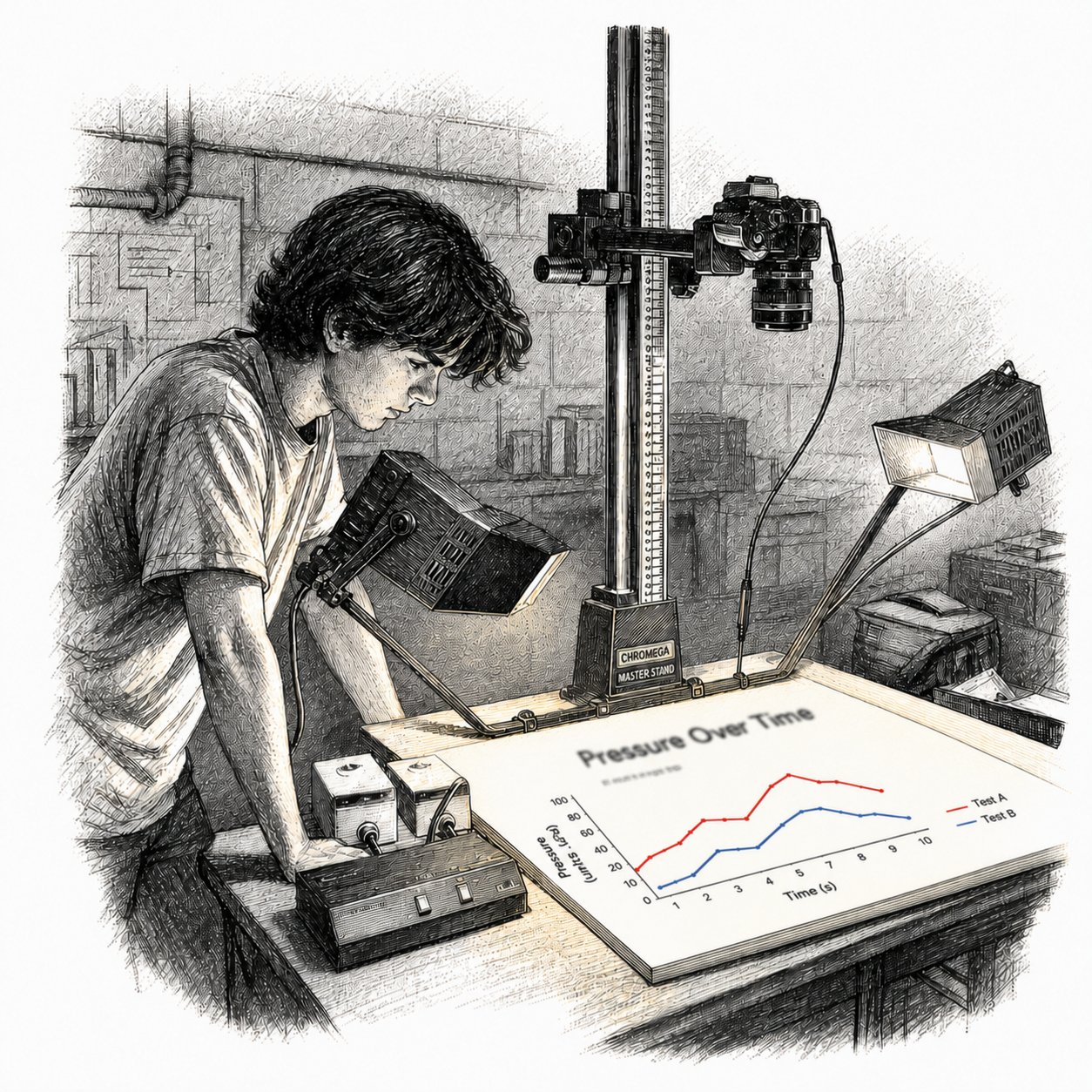
AI can build a great slide deck in minutes. I learned what makes a deck good when a single slide took an hour to create and cost real money. Those two facts are connected. In college I worked building presentations for my engineering department; I made slides by hand. Not slides in the PowerPoint sense. Rather a piece of film mounted in a frame that you ‘slide’ into a projector.
Here is what “making a slide” meant. I talked with the person giving the talk, organized the notes, wrote an outline, and listed every slide the deck needed. For some I had to photograph a real object or person, so I carried my camera to their lab and shot it onto slide film. For the rest I designed a layout, plotted the charts, arranged everything on a 16-by-20 sheet of paper, rubbed on the lettering by hand, and shot the page on a copy stand. Then I went into the darkroom, processed the film, and mounted each transparency. A full deck for a fifteen-minute talk might take eight hours. I could never fully get the smell of the chemistry off my hands.
The slides weren’t beautiful. They were largely monochrome, laid out simply, and limited in every way, a modern deck isn’t. I’m not here to tell you the handmade ones were better. They weren’t.
But every slide cost real effort and real money. So, I needed to avoid making a bad slide. Get a layout wrong and I started over from a blank sheet. Botch the film and I reshot the whole deck. And that cost was teaching me something underneath the work: what belonged on a slide, because I couldn’t afford to waste one. The friction was the quality control.
Then desktop software arrived, and the cost of production dropped by orders of magnitude. WordPerfect demanded discipline, VisiCalc demanded patience, and early PowerPoint demanded a sense of humor. They were a real improvement, and I will never go back to processing film. A wording change that used to cost an hour soon cost a few keystrokes.
The moment production became cheap, the discipline the friction used to enforce stopped being enforced by anyone. Nobody had to learn restraint anymore. And so, we got more bad presentations than ever. Microsoft, which owns PowerPoint, is famous for the worst of them — if a slide has fewer than a hundred words, is it even a Microsoft slide? The craft of good presentation design didn’t die. It just stopped being required to produce a deck.
The pattern is older than slides. Word processor split writing from typing. Spellcheck split spelling from writing. The calculator split calculation from knowing which formula actually matters. In each case the mechanical skill faded and almost nobody mourned it, because the judgment was the part that mattered, and the judgment survived. The tool takes the mechanical half of a craft and quietly keeps depending on the other half.
AI runs this same move to an extreme. Give Claude an article and it will build a well-designed deck in minutes; strong-looking points, a sensible amount per slide. It is often mostly good, because it is working from real source material, the known rules of presentation design, and solid templates.
But watch what it can’t do. It doesn’t know whether the deck is true. It doesn’t know whether the tone fits the audience. It doesn’t know whether slide 6 should exist at all. And it tends to pour the article straight into the deck as if a presentation and an essay share an arc — they don’t. An essay can build slowly; a talk has to land its point and let the room breathe. AI defaults to transposing the structure it was handed, because reproducing a known pattern is exactly what it’s good at. AI doesn’t know when to break the rules. The reframing is the judgment, and the judgment is still yours.
So, AI inverts the process I started with. On the copy stand, the labor was everything and the judgment was forced on me by the cost. Now the labor is gone, and the judgment is the whole job, sitting fully exposed. AI hands you production for free and quietly hands you the entire bill for judgment.
That’s not a warning. It’s the best news in the world if you have taste, and a real problem if you were coasting on production. The person who gets the most out of AI is the one who can look at the thirty-slide deck it just generated and know at a glance that slide 6 is a lie, that 9 through 11 are the same point three times, and that the argument the CEO actually needs isn’t in there yet.
I won’t claim I have top-tier judgment about slides. I don’t. But making them the hard way forced some on me, and that’s the part that carried over. Through every one of these transitions — word processing, presentations, spreadsheets — the tool took the mechanical skill and left the judgment standing. The craft that survives a tool is never the craft the tool replaced.
Which is why the old instinct still holds, even now. The best presenters won’t be the ones who prompt best. They’ll be the ones who can still look at a finished deck and know what’s working and what isn’t.
Brad Hinkel is a product leader with 25+ years across Microsoft, Amazon, Disney, and Google, currently focused on AI product management and human-AI workflow design.
Authored by Brad Hinkel, developed by Claude.
Leave a Reply